Work and Energy
Defining Work
The scientific definition of work is different in many ways from its everyday meaning. The definition of work in physics reveals its relationship to energy – whenever work is done, energy is transferred.
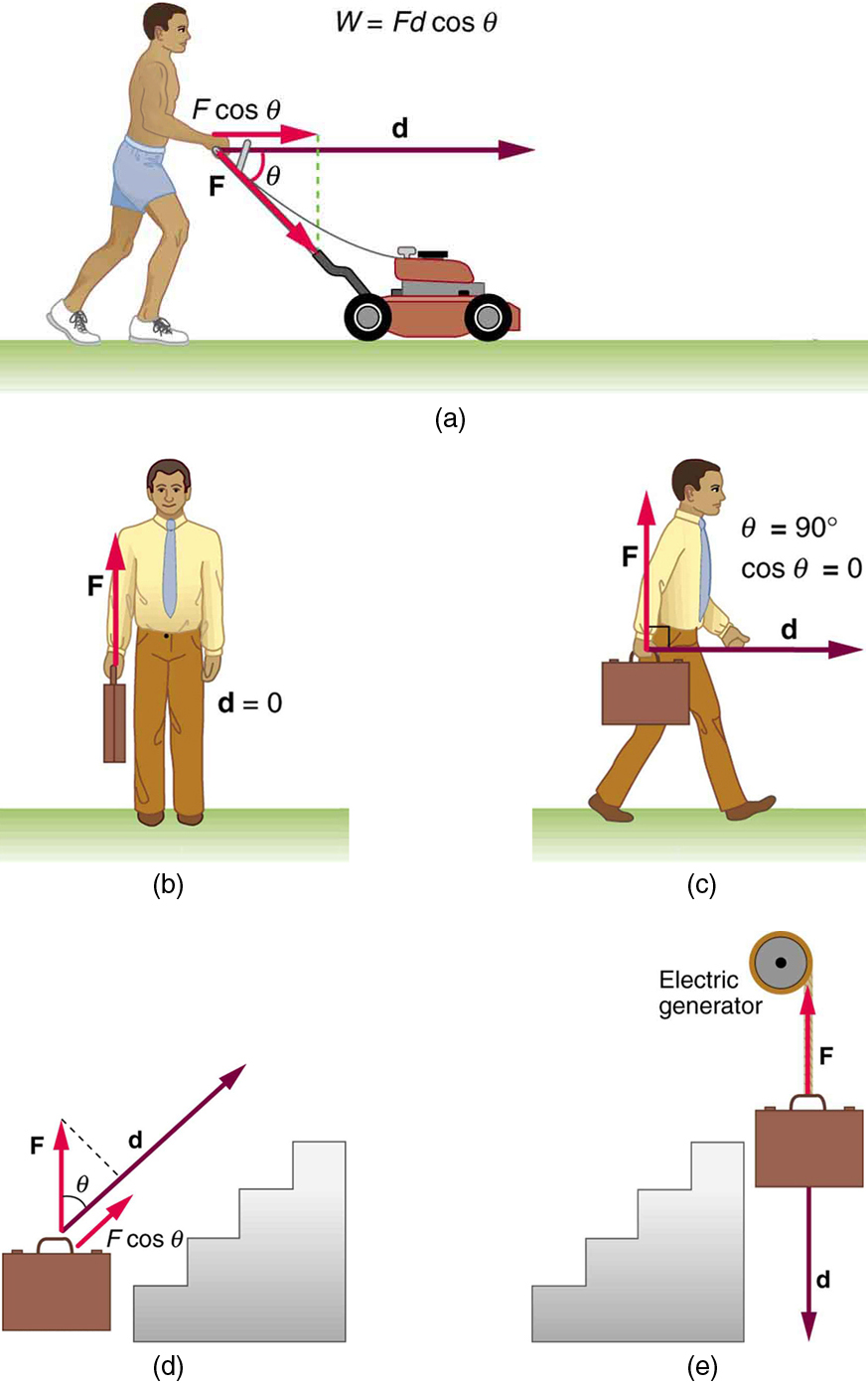
For a work to be done, in a scientific sense, a force must be exerted, and there must be displacement in the direction of the force. With this said, we can say that
Work is the product of the component of the force in the direction of the displacement and the magnitude of this displacement.
Mathematically, the above statement is expressed as follows:
W = (F cos θ) d = F. d
Where,
W is the work done by the force.
F is the force, d is the displacement caused by force
θ is the angle between the force vector and the displacement vector
The dimension of work is the same as that of energy and is given as, [ML2T–2].
Unit of Work
The SI unit of work is the joule (J), which is defined as the work done by a force of 1 Newton in moving an object through a distance of 1 meter in the direction of the force. A weightlifter lifts a barbell weighing 25 kg and displaces it from the ground by 2 m. Here, the work done upon the barbell is against gravity.
The work done upon the weight against gravity can be calculated as follows:
Work Done = (Mass × acceleration due to gravity) × Displacement
= (25 × 9.8) × 2 J
For Reference:
Work, Energy, and Power
Introduction To Heat, Internal Energy And Work
Work and Energy
Center Of Mass
Measurement of Mass
Mass and Momentum
Factors Affecting Work
Let us now consider the factors on which work done on an object by force depends.
Force: Force is a push or a pull that can cause any object with a mass to change its velocity and acceleration. Force is a vector quantity and has both a magnitude and a direction. If the force acting on an object is zero irrespective of the state of the object (dynamic or static), that work done by force is zero.
Displacement:
Displacement is a vector quantity that gives the shortest distance between the initial and final positions of any object. If the resulting displacement in the direction of force due to force acting on any object is zero, the net work done by that force on that object is zero. For e.g., if we push a rigid wall with all our might and still fail to displace it, then we can say no work has been performed on the wall.
The Angle between the Force Vector and the Displacement Vector
The work done by a force on an object can be positive, negative, or zero, depending upon the direction of displacement of the object with respect to the force. For an object moving in the opposite direction to the direction of force, such as friction acting on an object moving in the forward direction, the work is done due to the force of friction is negative. Similarly, an object experiences a zero force when the displacement angle is perpendicular to the direction of the force. Consider an example of a coolie lifting a mass on his head moving at an angle of 90˚ with respect to the force of gravity. Here, the work done by gravity on the object is zero.
What Is Energy?
There are different forms of energy on earth. The sun is considered the elemental form of energy on earth. In physics, energy is considered a quantitative property that can be transferred from an object to perform work. Hence, we can define energy as the strength to do any kind of physical activity. Thus, in simple words, we can define energy as, Energy is the ability to do work According to the laws of conservation of energy, “ energy can neither be created nor destroyed but can only be converted from one form to another”. The SI unit of energy is Joule.
Units of Energy
The International System of Units of measurement of energy is joule. The unit of energy is named after James Prescott Joule. Joule is a derived unit equal to the energy expended in applying a force of one newton through a distance of one meter. However, energy is also expressed in many other units not part of the SI, such as ergs, calories, British Thermal Units, kilowatt-hours, and kilocalories, which require a conversion factor when expressed in SI units.
Different Types of Energy
Although there are many forms of energy, it is broadly categorized into:
Kinetic Energy
Potential Energy
Kinetic Energy
Kinetic energy is the energy associated with the object’s motion. Objects in motion are capable of causing a change or are capable of doing work. To better understand, let us think of a wrecking ball. A wrecking ball in motion is used to do work such as the demolition of buildings, stones, etc. Even a slow-moving wrecking ball is capable of causing a lot of damage to another object, such as an empty house. However, a wrecking ball that is not in motion does not do any work. Another example of kinetic energy is the energy associated with the constant, random bouncing of atoms or molecules. This is also known as thermal energy. The average thermal energy of a group of molecules is what we call temperature, and when thermal energy is transferred between two objects, it’s known as heat.
Different Types of Kinetic Energy:
Radiant energy
Radiant energy is the type of energy that travels by waves or particles. This energy is created through electromagnetic waves and is most commonly experienced by humans in the form of heat. Following are a few examples of radiant energy: When you turn on an incandescent light bulb, it gives off two forms of energy. There is visible light and heat that is generated. Both these generated energies are a form of radiant energy. Sunlight is an example of radiant energy.
Thermal Energy
Thermal energy is similar to radiant energy and is experienced in the form of heat or warmth. While radiant energy refers to waves or particles, thermal energy describes the activity level among the atoms and molecules in an object. This is the only difference between radiant energy and thermal energy. Some examples of thermal energy include: The geothermal energy that comes from the decay of natural minerals and the volcanic action of the earth is an example of thermal energy. When you heat up the pizza in the oven, you raise the pizza’s temperature. The molecules that make up the pizza move more quickly when the pizza is piping hot. The warmth you feel emanating from the engine is an example of thermal energy.
Sound Energy
Humans experience the vibrations that reach the human ear as sound. The disturbance moves in the form of waves through a medium like air and reaches our eardrum. On reaching the eardrum, these vibrations are converted into electrical signals and sent to the brain, which we interpret as the sensation of sound.
Electrical Energy
The flow of negatively charged electrons around a circuit results in electricity which we more commonly refer to as electrical energy.
Mechanical Energy
Mechanical energy is the energy associated with the mechanical movement of objects. This type of energy can also be referred to as motion energy.
Potential Energy Potential energy is the energy stored in an object or system of objects. Potential energy can transform into a more obvious form of kinetic energy.
Different Types Of Potential Energy
Gravitational Potential Energy
Gravitational potential energy is the energy stored in an object due to its vertical position or height. A book on a high bookshelf has a higher gravitational potential energy than a book on the bottom bookshelf.
Gravitational Potential Energy Examples
River water at the top of a waterfall
A book on a table before it falls
A car that is parked at the top of a hill
Elastic Potential Energy
Elastic potential energy is stored as a result of applying a force to deform an elastic object. The energy is stored until the force is removed and the object springs back to its original shape, doing work in the process. The deformation could involve compressing, stretching or twisting the object.
Elastic Potential Energy Examples
A spring that is coiled
The string of an archer’s bow is pulled back
Rubber band that has been stretched
Chemical Potential Energy
Chemical potential energy is the energy stored in the chemical bonds of the substance. The energy can be absorbed and released due to a change in the particle number of the given species.
Chemical Potential Energy Examples
Before the sun shines on the green leaves (potential photosynthesis)
Gasoline before it is ignited
Fireworks before they are launched
Electric Potential Energy
Electric potential energy is the energy that is needed to move a charge against an electric field.
Electric Potential Energy Examples
An incandescent light bulb that is turned off
A radio tower that is not working
A black-light turned off
A television before it is turned on
Energy Conversion: Transfer and Transform
We know energy can be transferred from one form to another. The movement of energy from one location to another is known as energy transfer. We notice various energy transformations happening around us.
Following are the four ways through which energy can be transferred:
Mechanically – By the action of force
Electrically – Electrically
By Radiation – By Light waves or Sound waves
By Heating – By conduction, convection, or radiation
The process which results in the energy changing from one form to another is known as energy transformation. While energy can be transformed or transferred, the total amount of energy does not change – this is called energy conservation.
Frequently Asked Questions – FAQs
Q1 What is the standard unit of measurement for work?
The standard unit of measurement for work is Joule.
Q2 When a body falls freely under gravity, the work done by gravity is positive or negative?
If a force acting on a body has a component in the direction of displacement, then the work done by the force is positive. Hence, when a body falls freely under the influence of gravity the work done by the gravity is positive.
Q3 When a body slides against a rough surface, the work done by friction is positive or negative?
If a force acting on a body has a component in the direction opposite to displacement, then the work done by the force is negative. Hence, the work done by the frictional force on the body is negative.
Q4 Superman stops a truck from moving downhill by applying force in it. Is this an example of work being done?
No. As there is no displacement, no work is done. He is merely holding the car to prevent its descent down the hill.
Q5 A string is tied to an eraser, a person holds the string and applies a tension force to the string as it made to move in a circle at a constant speed. Is this scenario an example of work being done?
For uniform circular motion, the force acts perpendicular to the direction of the motion, so the force never does any work upon the object.
Q6 What happens to the total energy of the object falling freely towards the ground?
The energy remains constant.
Q7 What happens to the energy of a body on which work is done?
The body gains more energy.