Valency
What Is Valency?
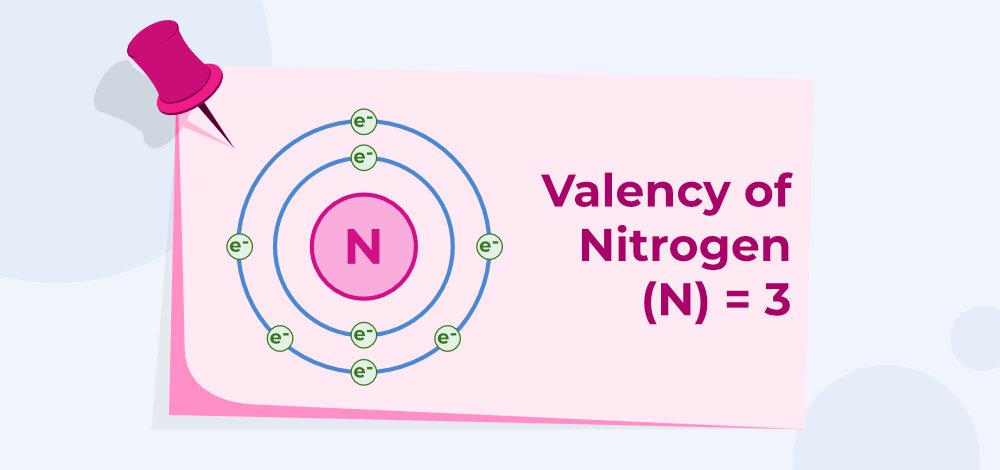
The combining capacity of an atom is known as its valency. The number of bonds that an atom can form as part of a compound is expressed by the valency of the element. We all know how electrons in an atom are arranged in shells/orbitals. Valence electrons are those electrons which are present in the outermost orbit of the atom. From the Bohr-bury scheme, we can say that the outermost shell can contain a maximum of 8 electrons. Only a little chemical activity is observed when the outermost shell is completely filled. We can also say that it’s combining capacity becomes zero. For example, nitrogen forms a number of compounds with hydrogen such as NH3, N2H4, N3H in which nitrogen atoms have valencies of 3, 2 and 1/3 respectively. Thus, this concept of valency as a mere number was not clear. Therefore, later on valency was defined as the number of chemical bonds formed by an atom in a molecule.
Concept of Valency
Noble gases have a completely filled outermost shell and that’s why they are least reactive. Other element’s reactivity depends upon their ability to attain the noble gas configuration. In this section, we shall learn more about the valency of an atom. If the outermost shell has 8 electrons then the element is said to have a complete octet. By gaining, sharing and losing the electrons the atoms complete their outermost orbital and make an octet. The capacity of an atom is described by the total number of electrons lost, gained or shared to complete its octet and it also determines the valency of the atom.
How to Find Valency of Elements?
As we know, the number of electrons in the outermost shell of hydrogen is 1, and in magnesium, it is 2. Therefore, the valency of hydrogen is 1 as it can easily lose 1 electron and become stable. On the other hand, that of magnesium is 2 as it can lose 2 electrons easily and also attain stability.
Furthermore, it is not only determined when an atom loses an electron. For example, fluorine has 7 electrons in its outermost orbital. It is hard to lose 7 electrons and so it completes its octet by gaining 1 electron. Since it gains 1 electron, its valency is 1. In the periodic table, the elements in the same group have the same valency. For example, all the elements in group 8 have 8 electrons and completely filled orbitals, that is why the valency of all the elements in this group is zero.
Difference between Valency and Oxidation Number
Valency is different from the oxidation number, and it has NO SIGN. Thus, the valency of nitrogen is 3, whereas it can have oxidation numbers from -3 to +5. The oxidation number is the hypothetical charge of an atom in a molecule or ion, and it is a measure of its apparent capacity to gain or lose electrons within that species.
Solved Example
Question: Calculate the valency of phosphorus in phosphorus pentoxide.
Solution: In Phosphorus pentoxide, two atoms of phosphorus have combined with five atoms of oxygen.
5 x 2 = 10 valency units
Therefore, one atom of phosphorus will have 10/2 = 5 valency units
So the valency of phosphorus in P2O5 is 5.