Reflection of Light
What is Reflection of Light?
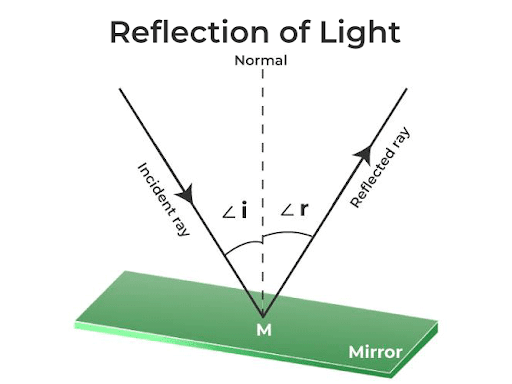
When a ray of light approaches a smooth polished surface and the light ray bounces back, it is called the reflection of light. The incident light ray that land on the surface is reflected off the surface. The ray that bounces back is called the reflected ray. If a perpendicular were drawn on a reflecting surface, it would be called normal. The figure below shows the reflection of an incident beam on a plane mirror. Here, the angle of incidence and angle of reflection are with respect to normal and the reflective surface.
Laws of Reflection
The laws of reflection determine the reflection of incident light rays on reflecting surfaces, like mirrors, smooth metal surfaces and clear water. Let’s consider a plane mirror as shown in the figure above. The law of reflection states that
The incident ray, the reflected ray and the normal all lie in the same plane
The angle of incidence = Angle of reflection
Types of Reflection of Light
Different types of reflection of light are briefly discussed below:
Regular reflection is also known as specular reflection
Diffused reflection
Multiple reflection
Multiple Reflection
A single image is formed when an object is placed in front of a mirror. What happens if we use two mirrors? Since reflective surfaces such as mirrors are very good at preserving the intensity of light in a reflection, a single light source can be reflected multiple times. These multiple reflections are possible until the intensity of light becomes low to the point that we cannot see. This means that we can have almost infinite multiple reflections. We can also see an image in every individual reflection. This means that each image is the result of an image or an image of an image. The number of images we see depends on the angle between the two mirrors. We see that as we go on decreasing the angle between the mirrors, the number of images increases. And when the angle becomes zero, i.e., when the mirrors become parallel, the number of images becomes infinite. This effect can be easily observed when your barber uses another smaller mirror to show you the back of your head. When this happens, not only do you see the back of your head, but you also see innumerable images of yourself.
Concave Mirrors and Convex Mirrors
A mirror is a surface that reflects almost all incident light. Mirrors come in two types: those with a flat surface, known as plane mirrors, and those with a curved surface, called spherical mirrors. In this article, we will explore two specific types of spherical mirrors: convex mirrors and concave mirrors. We will also delve into the concept of ray diagrams, which help us understand how light behaves when it interacts with these mirrors. By examining the ray diagram of a spherical mirror, we can gain insights into the fascinating phenomena of reflection and image formation.
What is a Mirror?
A mirror plays a fascinating role in reflecting light, resulting in the formation of images. When an object is placed in front of a mirror, we observe its reflection. Incident rays originate from the object, and the reflected rays converge or appear to diverge to create the image. Images formed by mirrors can be classified as real image or virtual image. Real images are produced when light rays converge and intersect, while virtual images are formed when light rays appear to diverge from a point. Ray diagrams are employed to comprehend the behaviour of light and better understand image formation. These diagrams use lines with arrows to represent incident and reflected rays, allowing us to trace their paths and interactions with the mirror. By interpreting ray diagrams, we gain valuable insights into how images are formed and a deeper understanding of how our eyes perceive objects through reflection.
Plane Mirror vs Spherical Mirror
A plane mirror is a flat, smooth reflective surface with a clear, undistorted reflection. When an object is reflected in a plane mirror, it always forms a virtual image that is upright, of the same shape and size as the object.
On the other hand, a spherical mirror exhibits a consistent curvature. It possesses a constant radius of curvature (In the context of spherical mirrors, the radius of curvature refers to the distance between the centre of the spherical mirror and its curved surface.). Spherical mirrors can create both real and virtual images, depending on the position of the object and the mirror. Spherical mirrors are further categorized into concave and convex mirrors, each with distinct properties and image formation characteristics.
Image Formation by Concave Mirror
The object’s position in relation to a concave mirror affects the type and characteristics of the image formed. Different scenarios result in different types of images:
Object at Infinity A real and inverted image is formed at the focus when the object is placed at infinity. The size of the image is significantly smaller than that of the object. Image formation when the object is placed at infinity
Object Beyond the Centre of Curvature When the object is positioned beyond the centre of curvature, a real image is formed between the centre of curvature and the focus. The size of the image is smaller compared to that of the object. When an object is placed behind the centre of curvature
Object at the Centre of Curvature or Focus When the object is placed at the centre of curvature, or the focus, a real image is formed at the centre of curvature. The size of the image remains the same as that of the object.
When an object is placed at the centre of curvature and focus Object Between the Centre of Curvature and Focus If the object is located between the centre of curvature and the focus, a real image is formed behind the centre of curvature. The size of the image is larger compared to that of the object. When an object is placed in between the centre of curvature and focus
Object at the Focus When the object is positioned exactly at the focus, a real image is formed at infinity. The size of the image is much larger than that of the object. When an object is placed at the focus
Object Between the Focus and the Pole Placing the object between the focus and the pole results in the formation of a virtual and erect image. The size of the image is larger compared to that of the object.
Frequently Asked Questions – FAQs
Q1 How do convex mirrors work? Convex mirrors are diverging mirrors that bulge outward. They reflect light away from the mirror, causing the image formed to be smaller than the object. As the object gets closer to the mirror, the image appears larger.
Q2 How do concave mirrors work?
Concave mirrors have a curved inward reflective surface. They reflect light inward towards a focal point. The image formed by a concave mirror varies based on the distance between the object and the mirror.
Q3 Give examples of concave and convex mirrors.
Examples of concave mirrors include torch lights and automobile headlights. Convex mirrors can be seen in magnifying glasses and telescopes.
Q4 What is the difference between a concave mirror and a convex mirror?
Concave mirrors have a reflective inner surface, while convex mirrors have a reflective outer surface.
Q5 Can you distinguish concave and convex mirrors without touching them?
Yes, you can. When an object is placed in front of a concave mirror, a magnified image is formed when the object is close to the mirror, and an inverted image is formed when the object is farther away. On the other hand, a convex mirror always forms a small and upright image of the object.
Q6 Can concave mirrors form virtual images?
Yes, concave mirrors can form virtual images when the object is within the focal point. These images are always upright and magnified.
Q7 What is the advantage of using a convex mirror?
The main advantage of convex mirrors is their wide angle of view, allowing for a larger area to be observed or monitored.