Production and Propagation of Sound
Sound Production
Where words cannot be heard, music speaks. Music and sound are part of our everyday life. A sound is a form of energy that gives us hearing experience. We see objects around us with the help of eyes by detecting light from objects. In the same way, ears are used to detect sound. The sound is produced by the vibration of objects and is propagated through a medium from one location to another. The to and fro or back and forth motion of an object is termed as vibration. The motion of objects causes vibrations. In many cases, we can see the vibrations with our naked eyes. While in some cases their amplitude is so small that we cannot see them but can experience them. The loudness of sound depends on its amplitude.
Examples of Sound Produced by Vibration of Objects
Let us understand the concept of sound produced by the vibration of an object with an example. We might have seen people playing the guitar. In guitar when they pluck the strings of a guitar, it vibrates and produces sound. The sound produced by it travels through the air which acts as the medium.
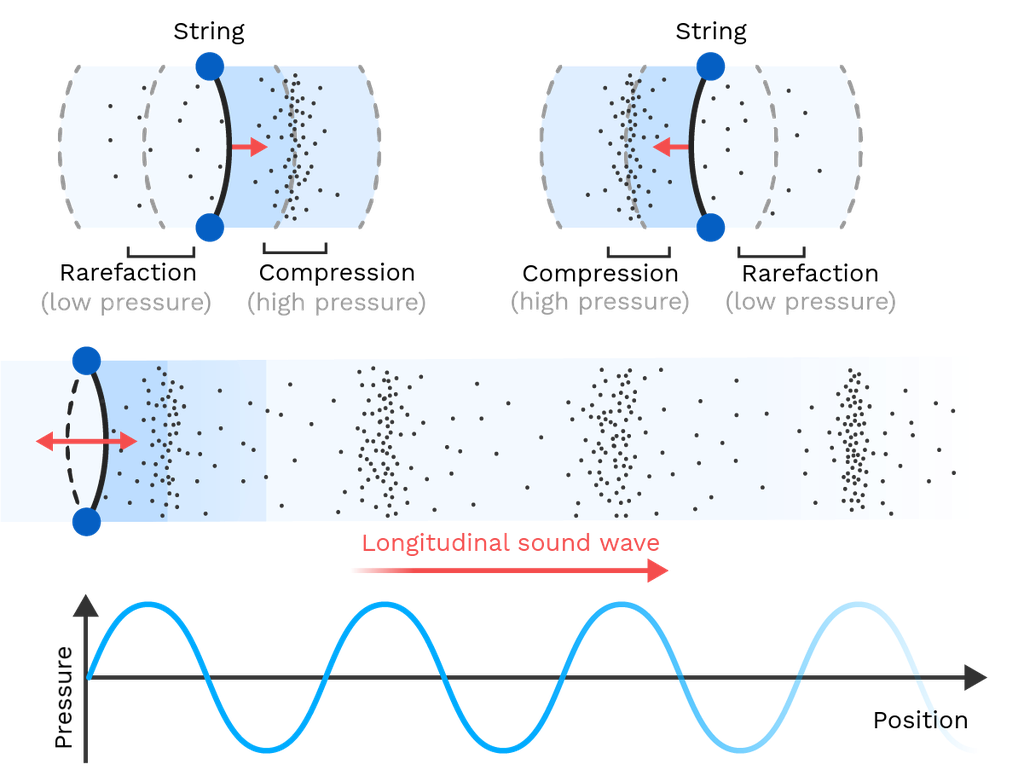
Another example to explain Sound Production by vibrating objects in a tuning fork. A fork consists of two tines and a handle. When it is hit with a rubber hammer, the two tines start vibrating. The back and forth motion of tines produce disturbances in the surrounding air molecules. As the tines extend outward from their original position, they compress surrounding air molecules which result in the creation of a high-pressure region close to the tine. When the tine moves inwards, it produces a low-pressure region near the tine. With more vibrations of tine, an alternating pattern of high and low-pressure regions is created. These pressure difference regions help in the propagation of sound waves from one location to another.
The sound produced is transmitted through pressure waves within the object. An object vibrating back and forth rapidly pushes air forward to make way for itself. When a force is applied on an atom, it moves from its original position and exerts a force on the adjacent atom. This motion from one particle to another continues throughout the medium. In this manner, the sound is transmitted through a medium.
What Is Propagation of Sound?
A sound is a form of energy, just like electricity, heat or light. Sound is one of the important senses of the human body. Some sounds are pleasant, and some are annoying. We are subjected to various types of sound all time. Sound waves are the result of the vibration of objects. Let’s examine some sources of sounds like a bell. When you strike a bell, it makes a loud ringing noise. Now, instead of just listening to the bell, put your finger on the bell after you have struck it. Can you feel it vibrating? This is the key to sound. It is even more evident in guitars and drums. You can see the wires vibrating every time you pluck it. When the bell or the guitar stops vibrating, the sound also stops.
The to and fro motion of the body is termed vibration. You can see examples of vibrations everywhere. Vibrating objects produce sound. Some vibrations are visible; some aren’t. If you pull and then release a stretched rubber band, the band moves to and fro about the central axis and while doing, so it also produces a sound. The sound moves through a medium by alternately contracting and expanding parts of the medium it is travelling through. In physics, the sound is a vibration that propagates as an acoustic wave, through a transmission medium such as a gas, liquid or solid.
Sound Wave Characteristics
After understanding what is sound, let us study the characteristics of the sound wave. The distance between two consecutive peaks or troughs is termed as the wavelength of the wave or the period. The number of cycles per unit time is termed as the frequency of the sound. Frequency is measured in cycles per second or Hertz.
The faster an object vibrates, i.e. the higher the frequency, the higher the pitch of the sound. The difference between the voices of a man and a woman must be clearly evident to you. The voice of a man has a lower frequency which contributes to the deepness of the bass in the voice. Women, in contrast, have a voice with higher frequency resulting in a higher shrillness or pitch.
Closing Our Ears When We Hear Loud Noise
If you hear a very loud sound, what do you do? You cover your ears. How do you think that helps? When you cover your ears, you shut off the air inside your ears from the rest of the atmosphere. The sound waves travelling around you are now unable to get through to your ear or the intensity of the sound you hear is greatly reduced. Blocking your ears creates a discontinuity in the medium due to which the flow of sound energy is disturbed. Through this, we can make a very important observation; Sound waves rely on the medium for propagation. The propagation of the sound wave is not possible through the vacuum. The medium here can be gas, liquid or solid. The speed of sound when it is travelling through a medium depends on the type of medium. The speed of sound when travelling through air is 343 m/s or 1,235 km/h.
Frequently Asked Questions – FAQs
Q1 What is meant by sound?
Sound is a form of energy that propagates as an acoustic wave. It is produced by the vibration of the objects.
Q2 Can sound travel through solid and liquid mediums?
Yes, sound can travel through solid and liquid mediums.
Q3 Which is the medium through which the sound cannot travel?
Sound cannot travel through vacuum.
Q4 State true or false: Sound is produced by vibrating objects.
TRUE.
Q5 What is noise? Noise is defined as excessive unwanted or unpleasant sounds.
List physical factors that affect sound propagation
Following are a few factors that affect the propagation of sound:
1. Atmospheric Turbulence: If the atmosphere in which the sound wave is travelling is turbulent, sound waves would scatter due to velocity fluctuations of the medium.
2. Wind Gradient: Sound propagating along the wind would bend downwards while sound propagating against the wind would bend upwards.
3. Temperature Gradient: Sound waves travel faster in a warm atmosphere near the surface of the earth. Here, there is upward refraction of sound waves. In case of a decrease in temperature at higher altitudes, the refraction would be downwards.