Newton’s All law of motion
Newton’s First Law
Newton’s first law of motion states that
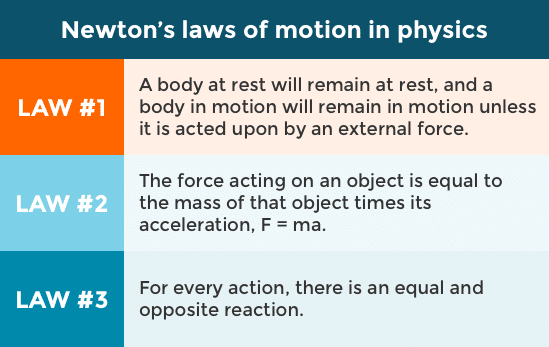
A body remains in the state of rest or uniform motion in a straight line unless and until an external force acts on it.
Putting Newton’s 1st law of motion in simple words, a body will not start moving until and unless an external force acts on it. Once it is set in motion, it will not stop or change its velocity until and unless some force acts upon it once more. The first law of motion is sometimes also known as the law of inertia. There are two conditions on which the 1st law of motion is dependent:
Objects at rest: When an object is at rest, velocity (v = 0) and acceleration (a = 0) are zero. Therefore, the object continues to be at rest.
Objects in motion: When an object is in motion, velocity is not equal to zero (v ≠ 0), while acceleration (a = 0) is equal to zero. Therefore, the object will continue to be in motion with constant velocity and in the same direction.
What is Newton’s Second Law of Motion?
Force is equal to the rate of change of momentum. For a constant mass, force equals mass times acceleration.
Defining Newton’s Second Law of Motion Newton’s second law states that the acceleration of an object depends upon two variables – the net force acting on the object and the mass of the object. The acceleration of the body is directly proportional to the net force acting on the body and inversely proportional to the mass of the body. This means that as the force acting upon an object is increased, the acceleration of the object is increased. Likewise, as the mass of an object is increased, the acceleration of the object is decreased.
Newton’s second law can be formally stated as,
The acceleration of an object as produced by a net force is directly proportional to the magnitude of the net force, in the same direction as the net force, and inversely proportional to the mass of the object.
Newton’s Third Law of Motion
You probably know that when you throw a ball against a wall, the ball exerts a force on the wall. Likewise, the wall puts force on the ball as a result of which the ball bounces off the wall. Similarly, earth pulls you down with gravitational force. What you may not realize is you are also exerting an equal amount of force on the earth. This remarkable fact is a consequence of Newton’s third law.
Newton’s 3rd Law: If an object A exerts a force on object B, then object B must exert a force of equal magnitude and opposite direction back on object A. This law signifies a particular symmetry in nature: forces always occur in pairs, and one body cannot exert a force on another without experiencing a force itself. In the next few sections, let us learn Newton’s third law in detail.
Newton’s Third Law of Motion
Force is a push or pull acting on an object resulting in its interaction with another object. Force is a result of an interaction. Force can be classified into two categories: contact force such as frictional force and non-contact force such as gravitational force. According to Newton, when two bodies interact, they exert force on each other, and these forces are known as action and reaction pairs, which is explained in Newton’s third law of motion.
Newton’s third law of motion states that “When one body exerts a force on the other body, the first body experiences a force which is equal in magnitude in the opposite direction of the force which is exerted”.
The above statement means that in every interaction, there is a pair of forces acting on the interacting objects. The magnitude of the forces are equal and the direction of the force on the first object is opposite to the direction of the force on the second object.
Examples of Interaction Force Pairs
A variety of action-reaction pairs are evident in nature. We have listed a few below, and they are as follows:
Propulsion of fish through water is an example of an action-reaction pair. A fish makes use of its fins to push water backwards. This push serves to accelerate the fish forwards. The size of the force on the water equals the size of the force on the fish; the direction of the force on the water (backwards) is opposite the direction of the force on the fish (forwards).
The flight of the bird is an example of an action-reaction pair. The wings of the bird push the air downwards. The air pushes the air upwards.
A swimmer pushes against the water, while the water pushes back on the swimmer.
Lift is created by helicopters by pushing the air down, thereby creating an upward reaction force.
Rock climbers pull their vertical rope downwards to push themselves upwards.