Motion and Measuring the Rate of Motion
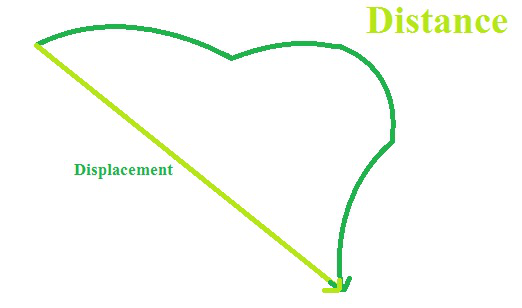
Introduction to Motion When we talk about motion or rest, it is with reference to some point known as the origin. So, now with respect to the change in the position, we have two quantities which can be used to describe that change in position. They are distance and displacement. So now the question is, what is the difference between the two? Talking about distance is defined as the total path length covered during the motion. It can be represented only by magnitude. On the other hand, displacement is the shortest distance between the initial and final positions. It requires both magnitude and direction for complete representation.
What Is Motion?
We can define motion as the change of position of an object with respect to time. A book falling off a table, water flowing from the tap, rattling windows, etc., all exhibit motion. Even the air that we breathe exhibits motion! Everything in the universe moves. We live in a universe that is in continual motion. The fundamental particle of matter, that is, the atom, is in constant motion too. Every physical process in the universe is composed of motion of some sort. The motion can either be swift or slow, but motion exists. It is important that we give due attention to the study of motion because of its importance in the physical world. Motion is mainly described in terms of the following terms:
Distance
Displacement
Speed
Time
As discussed earlier, distance and displacement are used to describe the change in position. Now, if someone asks what the distance between A and B is, we can’t give a definite answer because it depends on the path taken. It may or may not be the same for all three paths. But for displacement, we can always give a definite answer as it is a straight line joining the two points. In other words, displacement is nothing but the shortest distance between the two points, which in this case is Path 2. Also, it has a particular direction from A to B, as we can see. So now that we have a basic idea of both, we will try to solve an example: Suppose the distance between two cities, A and B, is ‘d’. A person goes from A to B and returns. Calculate distance travelled and displacement.
Distance travelled = Total path length covered = d + d
= 2d
Displacement is measured as the shortest distance between the initial and final position. In this case, both are the same, and hence, displacement is also zero. So for a motion, can displacement be greater than the distance covered? Think about it, and if not, can it be equal? You may also want to check out these topics given below!
Force And Motion
Change In State Of Motion
Newton’s Laws of Motion
Motion In Physics
Types Of Motion
We might have noticed that different objects move differently. Some objects move in a curved path, some in a straight path and a few others in a different way. According to the nature of the movement, motion is classified into three types as follows:
Linear Motion
Rotary Motion
Oscillatory Motion
Linear Motion
In linear motion, the particles move from one point to another in either a straight line or a curved path. The linear motion depending on the path of motion, is further divided as follows
Rectilinear Motion – The path of the motion is a straight line.
Curvilinear Motion – The path of the motion is curved.
A few examples of linear motion are the motion of the train, football, the motion of a car on the road, etc.
Rotatory Motion
Rotatory motion is the motion that occurs when a body rotates on its own axis. A few examples of the rotatory motion are as follows: The motion of the earth about its own axis around the sun is an example of rotary motion. While driving a car, the motion of wheels and the steering wheel about its own axis is an example of rotatory motion.
Oscillatory Motion
Oscillatory motion is the motion of a body about its mean position. A few examples of oscillatory motion are When a child on a swing is pushed, the swing moves to and fro about its mean position. The pendulum of a clock exhibits oscillatory motion as it moves to and fro about its mean position. The string of the guitar when strummed moves to and fro by its mean position resulting in an oscillatory motion.
Frequently Asked Questions – FAQs
Q1 State motion definition
As per motion definition, it is the change of position of an object with respect to time.
Q2 What are the types of motion?
The following are the types of motion:
Linear Motion
Rotary Motion
Oscillatory Motion
Q3 What are the types of linear motion?
Types of linear motion are:
Rectilinear Motion
Curvilinear Motion
Q4 State true or false: Displacement is measured as the shortest distance between the initial and final position.
TRUE
Q5 Give some examples of motion
Examples of motion are:
Walking
Running
The flow of air in and out of our lungs.
The automobiles that carry passengers from the place of pick up to the destination.
Measuring the Rate of Change of Motion
Motion is common to everything in the universe. We walk, run and ride a bicycle. Even when we are sleeping, air moves into and out of our lungs and blood flows in arteries and veins. We see leaves falling from trees and water flowing down a dam. Motion is change in position of an object with time. How does the position change with time ? In this chapter, we shall learn how to describe rate of change in motion.
Average Velocity
When an object is in motion, its position changes with time. But how fast is the position changing with time and in what direction? To describe this, we define the quantity average velocity
Average Velocity = Change in position/time interval
Vavg = (xf-xi)/(tf – ti)
Where xf and xi are the positions of the object at time tf and ti , respectively.The SI unit for velocity is m/s or m s–1, although km h–1 is used in many everyday applications.
1km/hr = 5/18 m/sec.
Average Speed
The magnitude of displacement may be different from the actual path length. To describe the rate of motion over the actual path, we introduce another quantity called average speed. Average speed is defined as the total path length travelled divided by the total time interval during which the motion has taken place :
Average speed = Total path length/Total time interval
SI unit = m s–1
It does not tell us in what direction an object is moving. It is always positive (in contrast to the average velocity which can be positive or negative). If the motion of an object is along a straight line and in the same direction, the magnitude of displacement is equal to the total path length. In that case, the magnitude of average velocity is equal to the average speed. If the motion of an object is not along a straight line and it’s motion may be same or different, the magnitude of displacement is not equal to the total path length. In that case, the magnitude of average velocity is not equal to the average speed.
Velocity (Rate of change of position)
The average velocity tells us how fast an object has been moving over a given time interval but does not tell us how fast it moves at different instants of time during that interval. For this, we define instantaneous velocity or simply velocity “v” at an instant “t”. The velocity at an instant is defined as the limit of the average velocity as the time interval ∆t becomes infinitesimally small. In other words,
vinst = dx/dt
Where (dx/dt) is the rate of change of position with respect to time, at that instant.
The SI unit for velocity is m/s or m s–1.
Instantaneous Speed or Speed
Instantaneous speed or simply speed is the magnitude of velocity.
Example: A velocity of + 24.0 m s–1 and a velocity of – 24.0 m s–1; Both have an associated speed of 24.0 m s–1.
It should be noted that though average speed over a finite interval of time is greater or equal to the magnitude of the average velocity.
Instantaneous speed at an instant is equal to the magnitude of the instantaneous velocity at that instant.
SI unit = m/sec
It does not tell us in what direction an object is moving.
Frequently Asked Questions – FAQs
Q1 What is speed? Speed can be considered as the rate at which a body covers distance.
Q2 What is the most common formula for calculating the speed of a moving body?
Speed is normally calculated by dividing the distance travelled by the time spent travelling the particular distance.
Q3 What is velocity?
Velocity can be defined as the directional speed of a body in movement as an implication if the body’s rate of change in position is perceived from a particular point of reference and as calculated by a specific standard of time. Example: 125km/h to the south.
Q4 What is average velocity?
The average speed of a body is calculated by dividing the total displacement by the total time taken. Average speed = Total distance travelled/Total time taken
Q5 What is acceleration? Acceleration is defined as the rate of change of motion of a body. In other words, the measure of the rate of change in its speed along with direction with respect to time is called acceleration.
Q6 What is momentum?
In Newtonian mechanics, momentum is the product of the mass of the moving body and its velocity. It is a vector quantity, having a direction and a magnitude.