Methods of purification
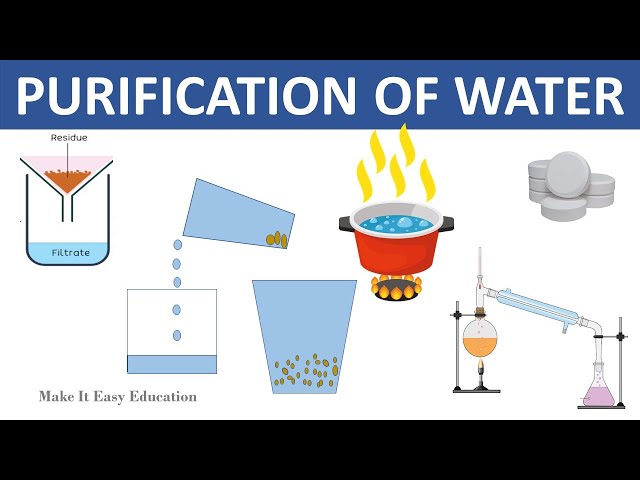
Purification of Organic Compounds
The purification of organic compounds is necessary, though a complex step after its extraction from a natural source or synthesis in the laboratory. The method of purification of the organic compound depends mainly on the nature of the compound and the impurities present. One easy method to check the purity of an organic compound is to either melt or boil it, as organic compounds tend to have sharp melting and boiling points. Purification means the removal of unwanted impurities present in an organic compound. The general methods of purification are listed below:
Sublimation
Crystallisation
Distillation
Differential Extraction
Chromatography
Methods of Purification
Sublimation
Some solids can directly pass to the vapour state without going through the liquid phase. The purification technique which exploits this property is called sublimation. It is helpful in separating sublimable compounds from non-sublimable ones.
The substance is heated in a China dish above, and an inverted funnel is kept to collect the sublimable compounds. The funnel is kept cool so as to hasten the process. Vapours of the substance solidify on the funnel.
Crystallisation
The principle here is that the compound and the impurities have different solubilities in a solvent. A solvent is chosen, where the compound to be purified is sparingly soluble, that is, it is sparingly soluble at a lower temperature and soluble at a higher temperature. The solution is heated to get a saturated solution, and on cooling, the crystals of the compounds are removed via filtration. For example, crystals of benzoic acid can be crystallised with water. Benzoic acid is sparingly soluble in cold water and soluble in hot water. If the mixture contains impurities that have the same solubility as that of the compound to be purified, repeated crystallisation is performed.
Purification of Liquids
Distillation
The underlying principle behind distillation is that the mixture of liquids can be separated by the difference in their boiling points. The boiling point is defined as the temperature at which the vapour pressure of the liquid is equal to the atmospheric pressure. This method separates volatile liquids from non-volatile liquids. The setup is given below. The mixture is taken in the RB flask and boiled. The more volatile, i.e., component with a lower boiling point, evaporates faster and is collected in a separate container. A condenser is used to hasten the process of condensation.
For example, a mixture of chloroform and aniline can be separated by distillation. The boiling point of chloroform is 60°C, and that of aniline is 189°C. Therefore, distillation can be used to separate a mixture of chloroform and aniline.
Fractional Distillation
This method is employed when the difference between the boiling points of the liquids isn’t much. Since the vapours of such liquids might condense together, a fractionating column is fixed to the mouth of the RB.
Vacuum Distillation
Since the boiling point is dependent on the atmospheric pressure, the liquids will boil at a temperature lesser than their boiling points if they were distilled in an atmosphere having lower pressure. This is achieved by using a vacuum pump. Since the atmospheric pressure is reduced, the liquids also boil faster, and hence the whole process of distillation is made fast.
Steam Distillation
In this variant, steam is passed into the flask containing the liquids to be separated. The principle here is that the liquids will boil faster because aqueous tension (vapour pressure of water) helps in equalising the atmospheric pressure. Total pressure = Aqueous tension + vapour pressure of liquid components
Chromatography
Chromatography is an important separation technique used to separate constituent particles of a mixture of substances to purify the compounds and check the purity of organic compounds. In this technique, on a stationary phase (solid or liquid), a mixture of substances is applied. The mixture of gas or the pure solvent is allowed to move slowly on the stationary phase. Due to this, the components of the mixture start separating from one another.
Chromatography is of two types:
Adsorption Chromatography
Partition Chromatography
Adsorption Chromatography
It is based on the principle that the constituents are adsorbed on an adsorbent in varying degrees. The adsorbents used are generally silica gel or alumina. When a mobile phase moves over the fixed phase, different constituents of the mixture get adsorbed at various distances over the fixed phase.
Check: Adsorption Chromatography
Adsorption Chromatography is further classified into:
Column Chromatography
Thin Layer Chromatography
Column Chromatography
Here, a mixture is separated over a column of either silica gel or alumina, packed in a glass column. The constituent with the most affinity with the fixed phase is adsorbed at the top, and so on. It is then retrieved by using an eluant. The solvent is then evaporated to get the constituent.