Formation and properties of ionic compounds
What is Ionic Compound?
Ionic compounds can be defined as:
The crystalline solids are formed by neatly packed ions of opposite charge. Ionic compounds are usually formed when metals react with non-metals.
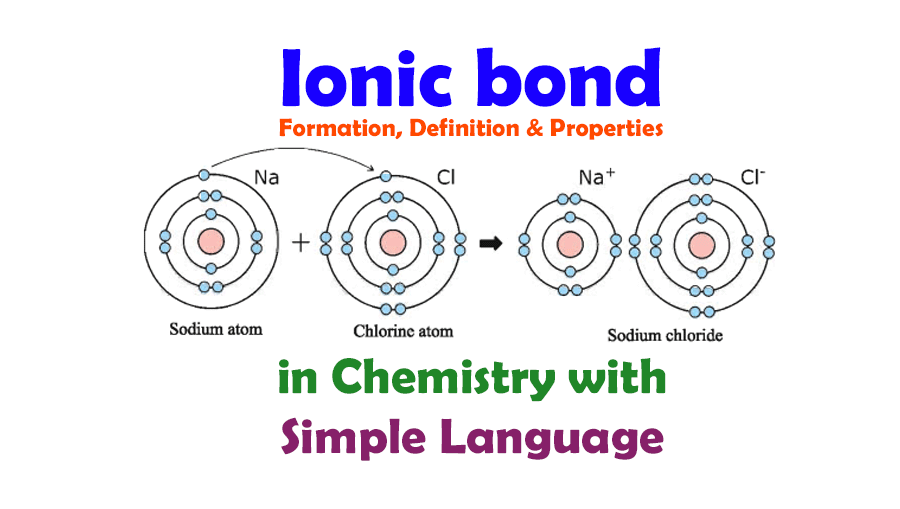
In other words, ionic compounds are held together by ionic bonds are classed as ionic compounds. Elements can gain or lose electrons in order to attain their nearest noble gas configuration. The formation of ions (either by gaining or losing electrons) for the completion of octet helps them gain stability.
In a reaction between metals and non-metals, metals generally loose electrons to complete their octet while non-metals gain electrons to complete their octet. Metals and non-metals generally react to form ionic compounds.
Ionic Compound Structure
The structure of an ionic compound depends on the relative sizes of the cations and anions. Ionic compounds include salts, oxides, hydroxides, sulphides, and the majority of inorganic compounds. Ionic solids are held together by the electrostatic attraction between the positive and negative ions. For example, the sodium ions attract chloride ions and the chloride ion attracts sodium ions. The result is a three-dimensional structure of alternate Na+ and Cl– ions. This is a crystal of sodium chloride. The crystal is uncharged because the number of sodium ions is equal to the number of chloride ions. The forces of attraction between the ions hold them in the structures.
Ionic Compound Examples
For example, the reaction between magnesium and chlorine. The magnesium atom has two electrons in its outermost shell. By losing two electrons from its M shell its L shell becomes the outermost shell that has a stable octet. The nucleus of this magnesium atom still has twelve protons but the number of electrons has decreased to ten. So, a net positive charge is developed on this magnesium atom, giving a magnesium cation Mg2+. On the other hand, the chlorine atom has seven electrons in its outermost shell. Therefore, it needs only one electron to complete its octet. It can gain this one electron from the electrons lost by the magnesium atom to become magnesium ion. As two electrons are lost by a magnesium atom while one chlorine atom can gain only one electron, two atoms of chlorine combine with one atom of magnesium to form magnesium chloride.
Ionic Compound Properties
1. Physical properties of ionic compounds
Due to the presence of the strong force of attraction between the positive and negative ions, ionic compounds are solids and are hard to break. They generally break into pieces when pressure is applied, hence they are considered brittle.
2. Melting and boiling points of ionic compounds
Due to the presence of electrostatic forces of attraction between ions, a large amount of energy is required to break the ionic bonds between the atoms. Thus, ionic compounds have high melting and boiling points.
3. The solubility of ionic compounds
Ionic compounds are generally soluble in polar solvents such as water whereas solubility tends to decrease in non-polar solvents such as petrol, gasoline, etc.
4. Conduction of Electricity
Ionic compounds do not conduct electricity in the solid-state but are good conductors in a molten state. Conduction of electricity involves the flow of charge from one point to another. In the solid-state, as the movement of ions is not possible, ionic compounds don’t conduct electricity. Whereas in the molten state, ionic compounds conduct electricity as electrostatic forces of attraction between the ions are overcome by the heat released.