Introduction to work, energy and power
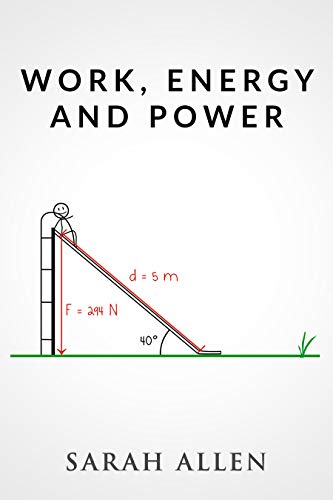
Work, Energy and Power
Work, Energy and Power are fundamental concepts of Physics. Work is said to be done when a force (push or pull) applied to an object causes a displacement of the object. We define the capacity to do the work as energy. Power is the work done per unit of time. This article discusses work, energy and power in detail.
What is Work?
For work to be done, a force must be exerted and there must be motion or displacement in the direction of the force. The work done by a force acting on an object is equal to the magnitude of the force multiplied by the distance moved in the direction of the force. Work has only magnitude and no direction. Hence, work is a scalar quantity.
Formula of Work
The work done by a force is defined to be the product of the component of the force in the direction of the displacement and the magnitude of this displacement.
Where W is the work done, F is the force, d is the displacement, θ is the angle between force and displacement and F cosθ is the component of force in the direction of displacement.
We understand from the work equation that if there is no displacement, there is no work done, irrespective of how large the force is. To summarize, we can say that no work is done if:
the displacement is zero
the force is zero
the force and displacement are mutually perpendicular to each other.
Unit of Work
The SI unit of work is Joule (J). For example, if a force of 5 newtons is applied to an object and moves 2 meters, the work done will be 10 newton-meter or 10 Joule. It should be noted that 1 J = 1 N ⋅ m = 1 kg ⋅ m2/s2.
Example of Work
An object is horizontally dragged across the surface by a 100 N force acting parallel to the surface. Find out the amount of work done by the force in moving the object through a distance of 8 m.
Solution:
Given:
F = 100 N, d = 8 m
Since F and d are in the same direction, θ = 0, [θ is the angle of the force to the direction of movement], therefore W = FdCos θ
W = 100 x 8 x Cos 0
W = 800 J [Since Cos 0 = 1]
Related Concepts
Introduction To Work Done
Work Energy Theorem And Its Application
What is Energy?
Energy is the ability to perform work. Energy can neither be created nor destroyed, and it can only be transformed from one form to another. The unit of Energy is the same as of Work, i.e. Joules. Energy is found in many things, and thus there are different types of energy.
All forms of energy are either kinetic or potential. The energy in motion is known as Kinetic Energy, whereas Potential Energy is the energy stored in an object and is measured by the amount of work done.
Types of Energy
Some other types of energy are given below:
Mechanical energy
Mechanical wave energy
Chemical energy
Electric energy
Magnetic energy
Radiant energy
Nuclear energy
Ionization energy
Elastic energy
Gravitational energy
Thermal energy
Heat Energy