Introduction to Current Electricity
Current Electricity
Many inventions and discoveries have been made in order to facilitate human life smoothly. The discovery of current electricity is one such discovery that we are highly dependent on to make our life easier. Benjamin Franklin is credited with the discovery of electricity.
What Is Current Electricity?
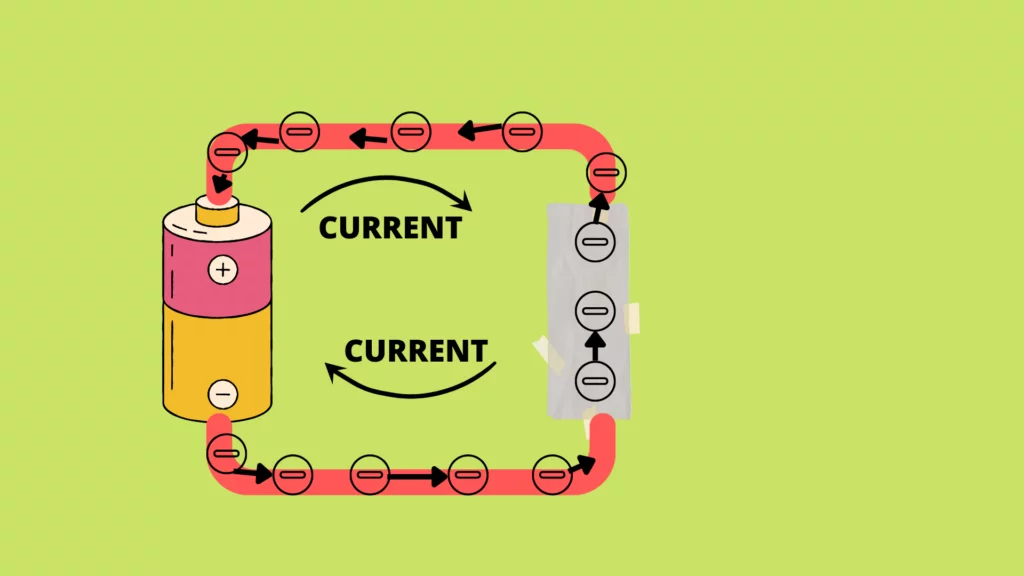
Current electricity is defined as the flow of electrons from one section of the circuit to another. When two bodies at different potentials are linked with a wire, free electrons stream from Point 1 to Point 2, until both the objects reach the same potential, after which the current stops flowing. Until a potential difference is present throughout a conductor, current flows.
From the above analogy, we can define electromotive force and voltage as follows:
Electromotive Force Definition: Electromotive force is defined as the electric potential produced by either an electrochemical cell or by changing the magnetic field.
Voltage Definition: Voltage is defined as the electric potential difference between two points.
Read More:
Unit of Voltage
Electromotive Force
Types of Current Electricity
There are two types of current electricity as follows:
Direct Current (DC)
Alternating Current (AC)
Direct Current
The current electricity whose direction remains the same is known as direct current. Direct current is defined by the constant flow of electrons from a region of high electron density to a region of low electron density. DC is used in many household appliances and applications that involve a battery.
Alternating Current
The current electricity that is bidirectional and keeps changing the direction of the charge flow is known as alternating current. The bidirectionality is caused by a sinusoidally varying current and voltage that reverse directions, creating a periodic back and forth motion for the current. The electrical outlets at our home and industries are supplied with alternating current.
Current Electricity vs Static Electricity
In this section, we will look into the difference between current electricity and static electricity:
What Is Static Electricity?
Static electricity refers to the electric charges that build up on the surface of materials or substances. These charges remain static until they are grounded, or discharged. This type of electricity is formed due to fiction. Basically, the phenomenon of static electricity arises when the positive and negative charges are separated.
Now let us look at the various differences between static electricity and current electricity.