The Human Eye & Defects of Vision And Their Correction
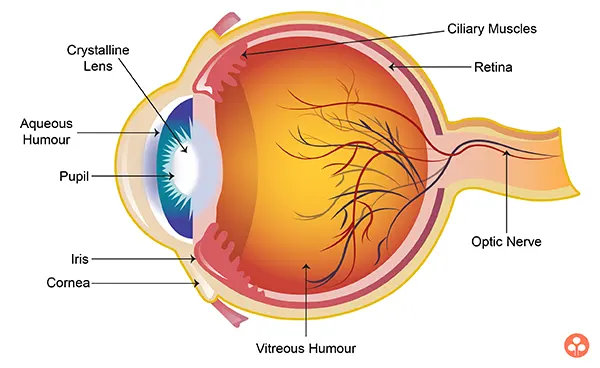
Human Eye
How do we see what we see? How do we perceive simple light rays as full-fledged images? Before getting into this, we should understand the important parts of the human eye and what their functions are.
The Cornea: Imagine this to be like a window to a human eye. The cornea contributes to the major refraction of light (bending of light rays) entering our eyes. It forms the clear front surface of a human eye. It also makes sure that foreign substances do not enter the eye.
The Iris: This lies right behind the cornea. It controls the circular opening called the pupil (aperture). It functions as an automatic camera shutter, controlling the amount of light entering a human eye.
The Crystalline Lens: The lens further focuses the light rays entering our eyes. Again, we can compare this to how an autofocus lens functions in a camera. This is called the accommodating power of the eye. Depending on where the object lies, the lens tries to focus on that object.
The Vitreous Humor: This is a jelly-like substance that fills most of the inner chamber of the eye. It helps the eye maintain its spherical nature. The light rays after passing through the opening, travel through the vitreous humour before striking the retina.
The Retina: It is a light-sensitive inner lining of the human eye. Ideally, light rays should focus on the retina, forming an image. It is the innermost lining of the inner tissue, which consists of the sclera and the choroid as well. When the light finally strikes the retina, an electric signal is sent to the brain (the visual cortex) via the optic nerve. The brain then processes the image and finally, we see what we see.
Myopia
The objects that are at a distance or nearby can be focused by the human eye due to their abilities. To watch nearby objects and focus on them, the eye’s lens has a short focal length. If the curvature of the lens is large, it will be able to focus on closer objects, whereas if the curvature is small, it will be able to focus on objects further far away. Most of the time, the effects of the defect start showing up at the extreme ends of the visual spectrum. Myopia or Nearsightedness occurs when the eye loses its ability to focus on far-off objects as the lenses do not possess a long focal length. Objects that are near are clearly visible to patients of this defect. As we know, from the reference for countless ray diagrams describing the functioning of the eye, when the light suffers higher refraction than usual, the eye would not be able to form an image for faraway objects.
Myopia Causes
Hereditary is one of the natural factors for a person to have the defect of myopia. If any of the parents have the defect, then there are chances that the child will inherit the same defect upon reaching adulthood. Predominantly young folks suffer from myopia which occurs due to elongation of the eyeball or bulging of the cornea. When the normal curvature of the cornea bulges, the light rays are refracted so that the image is formed in front of the cornea. The rods and cones of our eyes have areas where the image has the best clarity when the image is focused. Thus, as the image of the distant objects is not formed at the right spot, it is detected as blurry. Another worst cause of this type of eye defect is uncontrolled diabetes. Some unattended cataract growths may also lead to myopia.
Symptoms of Myopia
One of the common symptoms of Short-sightedness or Myopia is squinting and frowning. Short-sighted people may suffer from tired eyes and severe headaches by overstraining their eyes. One of the simplest symptoms is facing difficulty in reading the alphabets or letters from a specific distance. Myopia Formula The formula used to calculate the power of the correcting lens for myopia is by using the approximate formula of the focal length of combined lenses given as: