Gravitation, Freefall, Mass and Weight
What is Gravitation Force?
Each body in this universe attracts other bodies towards itself with a force known as Gravitational Force. Thus, gravitation is a study of the interaction between two masses. Out of the two masses, the heavier one is called source mass, and the lighter one is called test mass. Gravitational force is a central force which depends only on the position of the test mass from the source mass and always acts along the line joining the centres of the two masses. The core problem of gravitation has always been in understanding the interaction between the two masses and their relativistic effects. ⇒ Also, Check: Gravitational field intensity
History of Gravitational Theory
Ptolemy proposed the geocentric model, which failed to understand planetary motions, and led to the development of the heliocentric model by Nicholas Copernicus. His idea is based on the rotation of a test mass around the source mass in circular orbits; although the model correctly predicts the position of planets and their motions but has failed to explain many aspects, like the occurrence of seasons, which led to the construction of a model based on Kepler’s laws of planetary motion.
Newton’s Law of Gravitation
According to Newton’s law of gravitation, every particle in the universe attracts every other particle with a force whose magnitude is,
Directly proportional to the product of their masses, i.e., F ∝ (M1M2) . . . . (1)
Inversely proportional to the square of the distance between their centre, i.e., (F ∝ 1/r2) . . . . (2)
On combining equations (1) and (2), we get,
F ∝ M1M2/r2
F = G × [M1M2]/r2 . . . . (7)
Or, f(r) = GM1M2/r2 [f(r) is a variable, non-contact, and conservative force]
As f(r) varies inversely as a square of ‘r,’ it is also known as the inverse square law force. The proportionality constant (G) in the above equation is known as the gravitational constant.
The dimension formula of G is [M-1L3T-2]. Also, the value of the gravitational constant,
In SI units: 6.67 × 10⁻¹¹ Nm2 kg-2,
In CGS units: 6.67×10⁻⁸ dyne cm2 g-2
Gravitational Force Formula Gravitational force is explained using Newton’s law of gravitation. Gravitational force decides how much we weigh and how far a ball travels when thrown before it lands on the ground.
According to Newton’s law of gravitation, every particle in the universe attracts every other particle with a force that is directly proportional to the product of their masses and inversely proportional to the square of the distance between them.
Mathematically, it can be represented as,
F = Gm1m2/r2
Where,
F is the gravitational force between two objects measured in Newton (N).
G is the universal gravitational constant with a value of 6.674 × 10⁻¹¹ Nm2kg-2.
m1 is the mass of one massive body measured in kg.
m2 is the mass of another massive body measured in kg.
r is the separation between them measured in kilometre (Km).
Principle of Superposition of Gravitational Forces
Newton’s law of gravitation answers only the interaction between two particles; if the system contains ‘n’ particles, there are n(n – 1)/2 such interactions.
According to the principle of superposition, if each of these interactions acts independently and uninfluenced by the other bodies, the results can be expressed as the vector summation of these interactions:
F = F12 + F13 + F14 . . . . . . + F1n.
It states that:
“The resultant gravitational force F acting on a particle due to the number of point masses is equal to the vector sum of forces exerted by the individual masses on the given particle”.
Derivation of Newton’s law of Gravitation from Kepler’s Law
Suppose a test mass is revolving around a source mass in a nearly circular orbit of radius ‘r’ with a constant angular speed (ω). Then, the centripetal force acting on the test mass for its circular motion is,
F = mrω2 = mr × (2π/T)2
According to Kepler’s 3rd law, T2 ∝ r3
Using this in force equation, we get,
F = 4π2mr/Kr3 [Where, K = 4π2/GM]
⇒ F = GMm/r2, which is the equation of Newton’s law of gravitation.
Solved Examples
1. What is the force of gravity acting on an object of mass 2000 kg at the Earth’s surface?
Given:
Mass of Earth (m1) = 5.98 × 1024kg
Mass of object (m2) = 2000kg
The radius of the Earth (r)= 6.38 × 10⁶m
Acceleration due to gravity (g) = 9.8 m/s2
Universal constant (G) = 6.67 x 10⁻¹¹ N m2 / kg2
Solution:
F = Gm1m2/r2
F = ( 6.67 x 10⁻¹¹) (5.98 × 1024)(2 x 10³)/(6.38 × 106)2
F = (7.978 x 10¹⁷)/ (4.07044 × 10¹³)
F = 1.959 x 10⁴ or F = 19.59 N
2. What is the force of gravity acting on an object of mass 1000 kg at 20,000 meters above the Earth’s surface?
Given:
Mass of Earth (m1) = 5.98 × 1024kg
Mass of object (m2) = 1000kg
The radius of the Earth (r)= 6.38 × 10⁶m
Acceleration due to gravity (g) = 9.8 m/s2
Universal constant (G) = 6.67 x 10⁻¹¹ N m2 / kg2
h = 2 x 10⁴ m
Solution:
F = Gm1m2/(r +h)2
F = ( 6.67 x 10⁻¹¹) (5.98 × 1024)(1 x 10³)/(6.38 × 106 + 2 x 10⁴ )2
F = (3.988 x 10¹⁷)/(4.058 x 1013)
F = 9,827.50
F = 0.9827 x 10⁴
Frequently Asked Questions on Gravitation
Q1 Will your weight be constant when you are travelling to Greenland from Brazil?
No, it will increase. As the acceleration due to gravity is greater at the poles and lesser at the equator, because of the bulged oblate shape of the earth, we will feel heavier at Greenland. (Greenland is closer to the North Pole, and Brazil is closer to the equator).
Q2 Can you screen the effect of gravitation by any material medium?
No, the gravitational effect cannot be screened, unlike electrostatic force, because the gravitational force does not depend on any medium.
Q3 Why are space rockets launched eastward?
The Earth spins (rotates) from west to east in 24 hours. If the space rockets are launched in the same direction, the relative velocity of the rocket increases, which helps it to rise without much fuel.
Q4 Why does a bouncing ball bounce higher on hills than on planes?
As the altitude increases, the acceleration due to gravity decreases. Therefore, the ball bounces higher in hills than on planes.
Q5 The gravitational potential energy is negative. Why?
The reference point of zero potential energy is at infinity, and the gravitational force is always attractive. Therefore, the gravitational potential energy, which is the negative of work done, is always negative.
Q6 Why is Newton’s law of gravitation called universal law?
Newton’s law of gravitation holds good irrespective of the nature of the interacting bodies at all places and at all times.
Q7 What is the weight of the body at the centre of the Earth?
The weight of the body at the centre of the earth is zero.
W = mg = 0
(g at the centre of the earth is zero).
Q8 Does friction arise due to gravitation?
Friction does not arise due to gravitation. Its origin is electrical in nature.
What Is Free Fall?
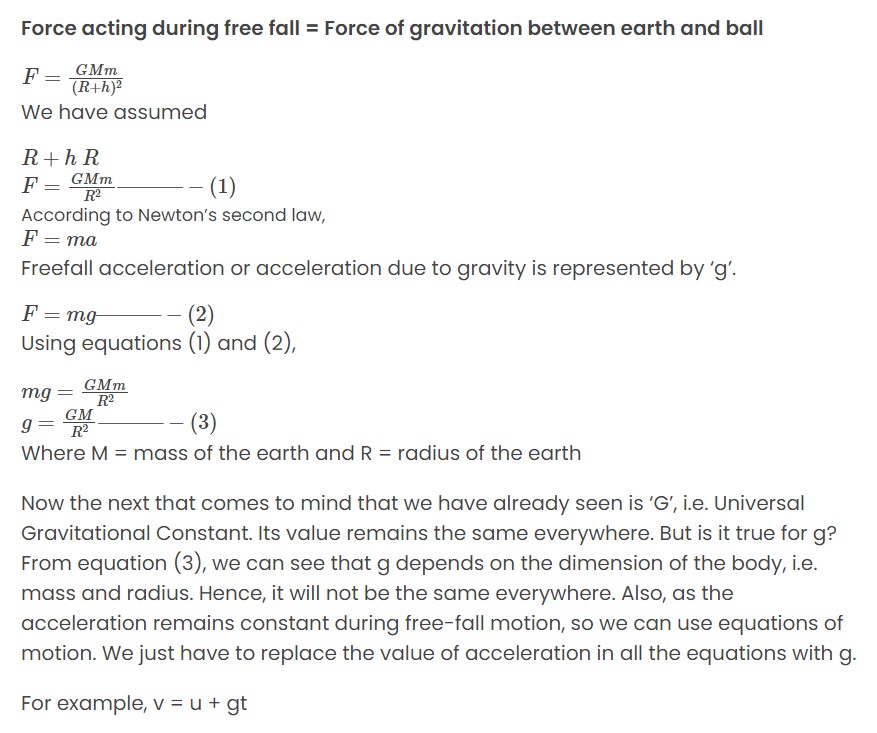
Freefall is defined as a situation when a body is moving only under the influence of the earth’s gravity. Since external force is acting on the ball, the motion will be accelerated. This free-fall acceleration is also known as acceleration due to gravity. Let us find the value acceleration due to gravity during free fall. To find this, we take one assumption that the height from which the ball is dropped is very small as compared to the radius of the earth.
Mass And Weight
What is Mass?
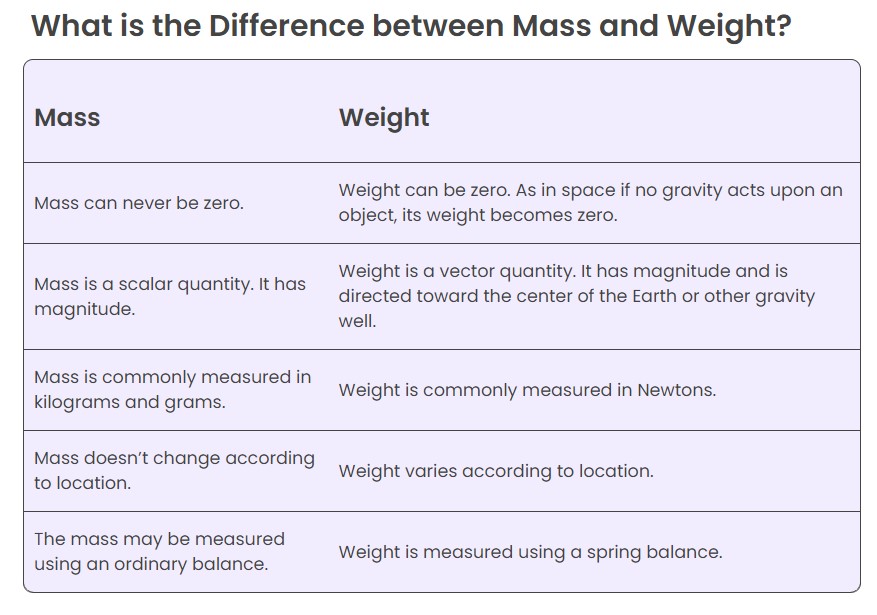
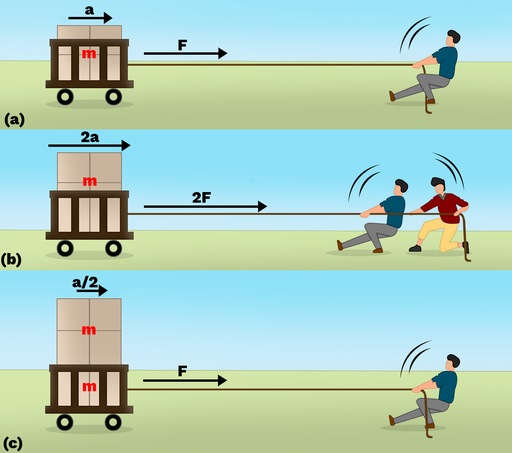
It is one of the fundamental quantities in Physics and the most basic property of matter. We can define mass as the measure of the amount of matter in a body. The SI unit of mass is Kilogram (kg).
Note: The mass of a body does not change at any time. Only for certain extreme cases when a huge amount of energy is given or taken from a body. For example: in a nuclear reaction, tiny amount of matter is converted into a huge amount of energy, this reduces the mass of the substance.
More On Mass
Measurement of Mass - Center of Mass
What is Weight?
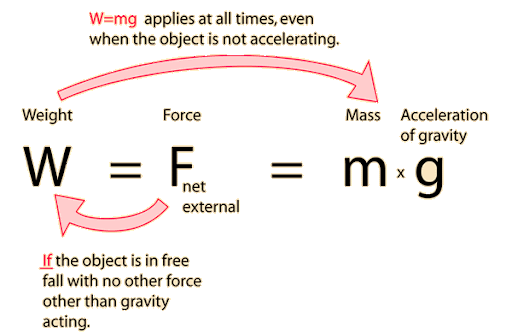
It is the measure of the force of gravity acting on a body.
The formula for weight is given by:
w = mg
As weight is a force its SI unit is also the same as that of force, SI unit of weight is Newton (N). Looking at the expression of weight we see that it depends on mass and the acceleration due to gravity, the mass may not change but the acceleration due to gravity does change from place to place. To understand this concept let’s take this example,
Shape of the earth is not completely spherical, but an oblate spheroid, therefore a person standing at the equator is far away from the center of the earth than a person standing at the north pole, as acceleration due to gravity is proportional to the inverse of the square of the distance between two objects, a person standing at the north pole would experience more weight as he is closer to the center of the earth than a person standing at the equator.
How is Weight Measured?
Following is the formula of a body which has a mass m and weight of magnitude w:
w = mg
So it can be said that the weight of an object is directly proportional to its mass.