Evaporation
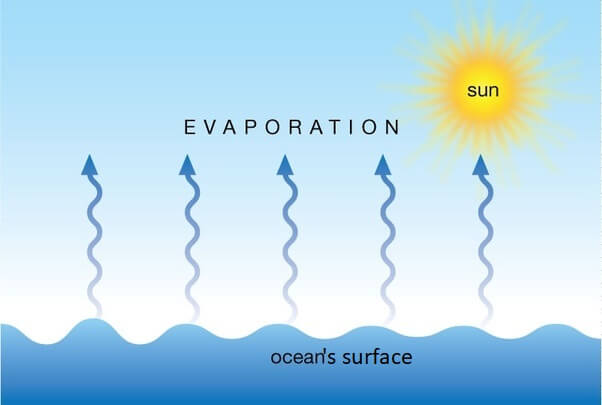
What is Evaporation?
Evaporation can generally be defined as a process by which a liquid is transformed into vapour.
When you spray perfume on your body, your body feels slightly cooler. The same goes for acetone and water. This is an effect of evaporation or the change of matter from its liquid state to its vapour state. The only difference is the rate at which the coolness is felt. In the case of acetone, the part of your body that is in contact with the liquid will cool the fastest. This happens because the evaporation rate of acetone is higher than that of water or perfume.
Evaporation is a form of vaporisation that usually happens on the surface of liquids and it involves the transition of the liquid particles into the gaseous phase. Therefore, this process is said to involve a change in the state of matter of liquids. The surrounding gas must not be saturated with the substance which is evaporating. They transfer energy to each other as the molecules of the liquid collide, depending on how they collide with each other. The liquid particles will generally escape and enter the surrounding air as a gas when a molecule near the surface consumes enough energy to overcome the vapour pressure. The energy extracted from the vaporised liquid as evaporation occurs will decrease the temperature of the liquid, resulting in a process known as evaporative cooling.
How does Evaporation Cause Cooling?
• Evaporation causes cooling naturally. The underlying principle behind this is that in order to change its state, the matter must either gain or lose energy. In the case of change of phase from liquid to gas, molecules of matter require energy to overcome their potential energy by their kinetic energy. So, the liquid takes this energy from its surroundings.
• Generally, when energy transfer occurs, it results in an increase or decrease in the temperature of the substance, depending on whether the energy is being transferred from the substance to the surroundings or vice versa. However, there are exceptions to this rule.
• Although there is an increase in temperature of the substance until the boiling point is attained during evaporation, phase change results in no observable heat transfer.
• The molecules of the substance absorb heat energy continuously from the surroundings and thus cool the surroundings until they reach the boiling point, after which they start to break free from the liquid and turn into vapour. Since there is no change in temperature till the evaporation process is complete i.e. the entire liquid gets converted into vapour, the amount of energy required for this phase change is called the latent heat of vaporization, where the word ‘latent’ means ‘hidden’, meaning this heat will not change the temperature reading on a thermometer.
Applications of Evaporative Cooling
• We sweat in order to cool our bodies. Perspiration is essentially evaporation. Water from our body evaporates, taking energy from our body in the process and thus resulting in the lowering of our body temperature.
•During the summer, we wear cotton clothes. Cotton, being a good absorber of water allows more sweat to be in contact with the atmosphere, consequently helping in more evaporation. It is for this reason that we feel cooler when we wear cotton clothes.
• Water is stored in earthen pots to make it cool. The pores of the earthen pot, just like the pores of cotton cloth provide a larger surface area for more evaporation.
• An air cooler is more effective on hot, dry days. The basic principle behind the working of an air cooler is evaporative cooling. On a hot, dry day, the temperature is high and humidity is low, the evaporation rate is higher. The water takes energy from the air and gets converted to vapour. This makes the air cooler.