Energy Stored in a Capacitor
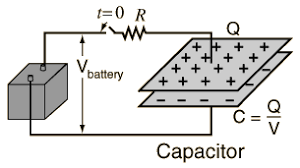
Energy Stored by Capacitor
We know that a capacitor is used to store energy. In this module, we will discuss how much energy can be stored in a capacitor, the parameters that the energy stored depends upon and their relations.
How to Calculate the Energy Stored in Capacitor?
Work has to be done to transfer charges onto a conductor against the force of repulsion from the already existing charges on it. This work done to charge from one plate to the other is stored as the potential energy of the electric field of the conductor.
C = Q/V
Suppose the charge is being transferred from plate B to A. At the moment, the charge on the plates is Q’ and –Q’. Then, to transfer a charge of dQ’ from B to A, the work done by an external force will be
Frequently Asked Questions on Energy Stored in Capacitor
Q1 Does energy get stored in a capacitor?
Yes, in a capacitor, the energy gets stored in the space between the two plates.
Q2 What type of energy is stored in a capacitor?
Electrostatic potential energy gets stored in the capacitor. It is, thus, related to the charge and voltage between the plates of the capacitor.
Q3 Where does the energy stored in a capacitor reside?
When a charged capacitor is disconnected from a battery, its energy remains in the field in the space between its plates.
Q4 How to increase the energy stored in a capacitor?
The energy of the capacitor depends on the capacitance and the voltage of the capacitor. If the capacitance, voltage or both are increased, the energy stored by the capacitor will also increase. A dielectric slab can be added between the plates of the capacitor to increase the capacitance of the capacitor.